
How Long Does Outbound Take?
How long outbound really takes: a stage-by-stage timeline from infrastructure to qualified pipeline, with a check for each stage. See the plan.

By Maxime Pudzeis, Founder, Kaizen Agency
· 6 min read
How long does outbound take to work? Four to eight weeks for the first replies and meetings, and 60 to 90 days for qualified pipeline your sales cycle can close. The exact pace depends on your infrastructure, your offer per segment, and how fast someone owns every reply.
Why the timeline question has no single number
Deal size, sales cycle length and how ready your sending infrastructure is all move this number. A five-figure deal with one decision maker moves faster than a six-figure deal with a buying committee. A cold domain needs weeks of warm-up before it can send real volume. None of this is an excuse. It is why a fixed number does not survive contact with a real company. This guide breaks the timeline into stages, each with a way to check if you are on track, inside a full B2B customer acquisition strategy.
For one of my clients, I built the outbound engine from zero: no budget, no team, no brand to lean on. Outbound, paid and inbound were built as one engine rather than three separate bets. Eighteen months later, qualified pipeline had moved from zero to three million euros, and revenue from zero to one million. What made those months count was not speed. Each stage below had a test attached to it, and the next stage only started once the previous one passed. A list that was never checked against closed deals, or a message nobody replied to, does not get better by sending more of it next week.
The stage-by-stage timeline, with a check at each stage
Each stage has a test. The next one starts when the previous one passes.
Domains warmed, SPF, DKIM and DMARC set, first sequences drafted.
Not there? Look at the domain setup, not the sequence copy.
A positive reply rate you can measure per segment.
Not there? Look at the offer per segment, not the send volume.
Meetings booked from replies, not opens being tracked.
Not there? Look at reply handling, not the channel.
A weekly rhythm exists, and one number, qualified pipeline, is reviewed.
Not there? The list, the offer or the infrastructure.
Your sales cycle sets this pace, not outbound.
Not there? Your close process, not the outbound system.
Weeks 1 to 2: infrastructure
Sending domains separate from your main company domain, warmed gradually, with SPF, DKIM and DMARC configured correctly. This is also when the first sequences get drafted and the target list gets built. Skipping this stage to send faster is the single most common way to damage deliverability for months. This is the same B2B outbound sales strategy infrastructure step, just measured here on a clock.
Weeks 3 to 4: first replies
The done-when test here is a measurable positive reply rate per segment, not a total number of sends. If replies are not coming in by week four, the fix is usually the offer per segment, not more volume on the same message. A vague offer sent faster still gets ignored faster.
Month 2: first meetings
Meetings booked from actual replies, not opens tracked in an email tool. If replies are happening but meetings are not, look at reply handling: who owns the reply, how fast they respond, and whether the CRM stage moves the moment someone answers.
Month 3: the checkpoint
By month three, a weekly rhythm should exist, with one number reviewed every week: qualified pipeline created. If there is no signal by month three, the honest diagnosis is the list, the offer or the infrastructure, not "outbound doesn't work." Rebuilding one of those three usually restarts the clock faster than waiting longer on the same setup.
Months 4 to 6: pipeline becomes revenue
Your own sales cycle sets this pace. A five-month cycle turns pipeline into signed revenue faster than a twelve-month one, and outbound cannot compress that gap on its own. What outbound controls is how much qualified pipeline enters that cycle in the first place.
Why enterprise and long sales cycles take longer
A buying committee adds a review step at every stage: the first reply might come from someone who cannot say yes alone, and the meeting that follows often exists to find out who else needs to be in the room. An unfamiliar market adds a similar delay, since trust has to be built before a claim gets believed. None of this means the timeline above is wrong. It means each stage takes longer per deal, without changing the order the stages happen in.
What building it in-house changed about the offer
The same client's sales cycle shortened from twelve months to five once the offer changed to sell the specific problem the product killed, instead of the commodity category it sat in. That change did not happen in week one. It happened once the first replies showed which framing actually got a response, and the offer got rewritten around it while the sequences kept running. The lesson: do not wait for a perfect offer before the first send. Use the early replies as the signal, and adjust the offer while the system keeps moving.
Outbound in Europe: does GDPR change the timeline?
The mechanics do not change. The ramp-up does. A new sending domain still needs a slow daily volume increase over two to three weeks regardless of where your contacts sit, and every message needs a clear, one-click opt-out honoured immediately, with a plain statement of where the contact data came from. This is not legal advice, and rules vary by country and by how the data was sourced, so check with your national data protection authority for anything beyond these basics.
Common mistakes that make the timeline look broken
- Judging the campaign by opens instead of replies. A high open rate with no replies tells you the subject line worked and the message did not.
- Nobody owns replies. The clock stalls the moment a reply sits in an inbox nobody checks.
- One message sent to every segment. A message vague enough to fit every industry convinces nobody it was written for them.
- Stopping the sequence after one quiet week instead of checking the offer first.
- Buying more data instead of fixing the list or the message. A bigger list on the same underperforming offer just produces silence faster.
FAQ
How many touchpoints does it take to convert an outbound lead?
There is no fixed number, since list quality, offer strength and industry all change how many touches it takes. Most sequences run several touches across two to three weeks rather than one email. Stopping after one or two messages is a far more common mistake than sending too many.
Is outbound sales the same as cold calling?
No. Cold calling is one channel inside outbound. A full B2B outbound sales strategy usually runs cold email and LinkedIn messaging together, often adding calling later once a message has already proven it gets replies.
How long should I wait before judging a new outbound campaign?
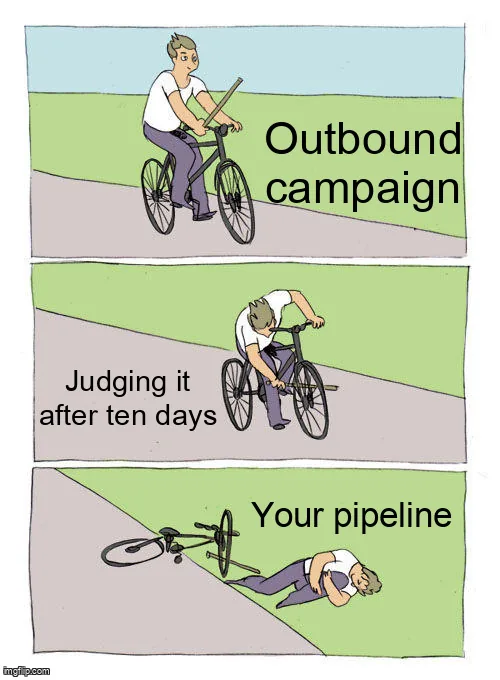
Give it the full 60 to 90 days described above before concluding anything. Judging after one or two weeks catches noise, not signal, since infrastructure and first replies both need that window to show a real pattern.
What is a realistic timeline for an SME with no in-house SDR?
The same stages apply, just paced by however much time the founder or the team can give it each week. A part-time effort stretches weeks one and two into three or four, but the checkpoint test at month three stays the same: a rhythm, and one number reviewed weekly.
Should I run outbound alone or alongside paid and inbound?
Outbound alone can prove an offer fast, but it works best as one part of a bigger system. Once outbound shows which offer and segment convert, paid and inbound can both build on that signal instead of guessing at their own.
Not sure which stage your own outbound is stuck at? A 4-minute diagnostic scores where your acquisition leaks today.